Distance
4.89 km
Elevation gain
458 m
Route type
out-and-back
Difficulty
Moderate
Peaks on this trail
About this trail#
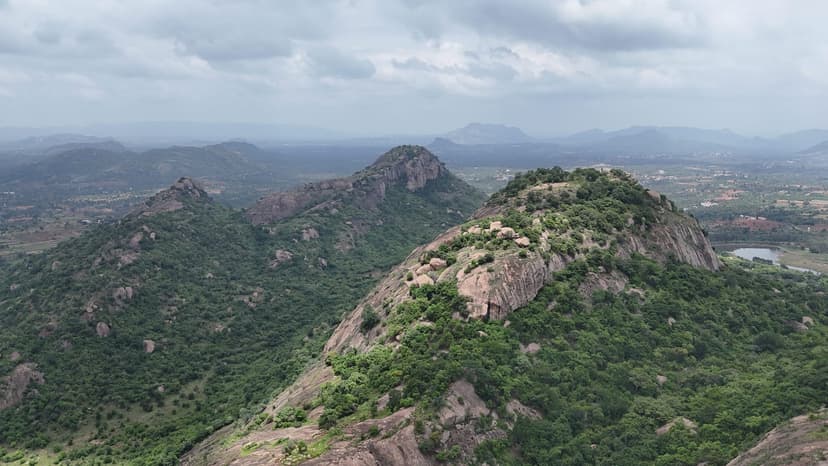
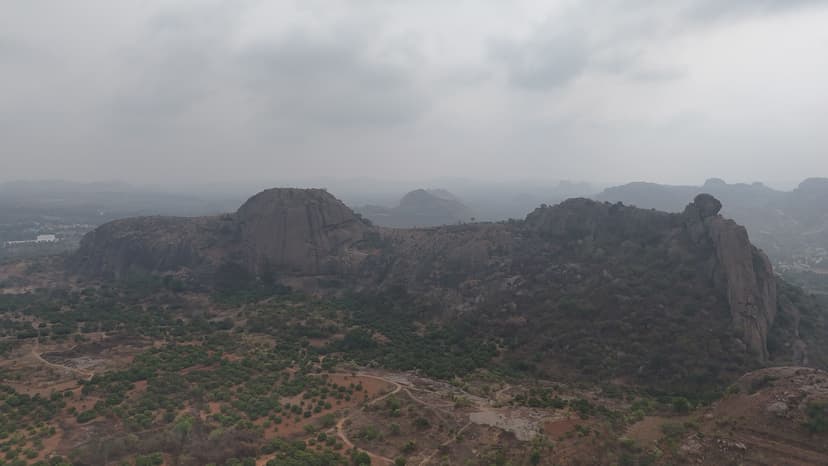
Bilikal Rangaswamy Betta is a forested granite hill named for the pale granite exposed at its summit: "bilikal" means white rock in Kannada. A Ranganathaswamy (Perumal) temple sits at the top, built against a large granite boulder, and draws pilgrims on Saturdays. Two routes reach the summit: a jeep track controlled by a Karnataka Forest Department checkpost, and a walking trail through the same protected forest. The walking trail climbs through tamarind-shaded farmland before entering dry deciduous forest. A wildlife trench marks the sanctuary boundary: a deep concrete ditch built to limit elephant movement into surrounding farmland. From that point onward, elephant dung is commonly found along the trail. The trek route carries no formal checkpost, but it runs through a wildlife corridor in restricted forest. The final section is steep, on loose rock, and slippery after rain.
Trail Information#
Farmland Approach
The trail begins at the edge of cultivation, passing through tamarind and custard apple trees. Forest department warning boards mark the entry into protected forest shortly after.
Wildlife Trench
A deep trench runs along the sanctuary boundary, built to limit elephant movement into surrounding farmland. Cross at the designated gap to enter the forest.
Forest Climb
The path is narrow and single-file, climbing continuously. Elephant dung is common throughout this section. The loose-stone surface demands care on descent and is hazardous when wet. Keep noise up and move in a group.
Summit and Temple
The canopy opens onto pale granite at the top. The Ranganathaswamy (Perumal) temple sits against a large boulder at the summit. A small water tank is located near the temple.
Getting there#
Trail route
Route flyby#
Preview the terrain before you go — a 3D fly-through of the full route.
GPX file#
Download the GPX route to use with your GPS device or hiking app. Learn how to use GPX files. To protect our trail data from bulk harvesting, downloads are limited to one per account per week.
🗺️
Sign in to download
Create a free account to download the GPX file and use it with your GPS device or hiking app.
Trail reports#
Trail conditions and experiences shared by hikers who've done this route

Wildlife & Nature#
Elephant dung is commonly found along the trail from the wildlife trench onward. This section of forest is an active elephant corridor. Treat fresh dung, uprooted vegetation, or alarm calls from langurs and spotted deer as signals to stop and assess before continuing.
Camping#
Camping is not permitted. The trail lies within protected forest administered by the Karnataka Forest Department. No overnight stays are allowed.